What is Staff Augmentation and How to Use It to Scale Your Business
In a place where life moves fast and ever-changing, companies constantly seek ways to enhance their operational capacity and leverage their employees to meet increasing competition requirements. The demand for flexible, expert IT talent has skyrocketed, driven by the pace of digital transformation and the need to optimize costs. One of the methods that has begun to catch on in people's minds over the past few years is staff augmentation.
With this method, an organization can instantly expand its team, access specialized skills, and attract global talent without the long-term commitment of hiring permanent employees. But what is meant by staff augmentation? What benefits would it hold for your business? In the dynamic digital landscape, Axalin's mission is to empower organizations through innovative IT solutions, strategic guidance, and expert support, enabling them to harness technology's full potential and achieve sustainable growth. This approach is intrinsically tied to Strategic Talent Solutions, including staff augmentation.
In this deeply detailed guide, you will find a complete analysis of the staff augmentation model, an explanation of how it operates, its merits and demerits, plus how the model can be successfully integrated within your organization.
What is the Staff Augmentation Model?
Staff augmentation is termed as a flexible outsourcing strategy through which a company can hire external personnel only for specific projects or use them to fill gaps in existing teams on an interim basis. This model is a powerful solution for businesses facing skill shortages, tight deadlines, or changing project needs.
Under staff augmentation, unlike traditional outsourcing, where the external company takes full responsibility for the service or delivery of a project, the external professionals join the existing in-house team. That means a business can contract temporary or contract-based workers who will work with their in-house employees. This could either be based on a short-term or long-term basis, depending entirely on the need.
Coming with staff augmentation services is access to highly specialized skills, which are mostly unavailable in the existing workforce, and it enables fast ramp-up or scale-down opportunities based on need. This approach gives you full control over execution—augmented specialists to work as part of your team, following your processes, tools, and coding standards, while the HR overhead is handled by the vendor.
How Does the Staff Augmentation Model Work in Practice?
With the staff augmentation strategy, professionals seek assistance from a third party or vendor in locating and bringing external professionals into the company. They are aligned with exactly what you need in business, and then these external workers become part of your team, working alongside your existing employees, but employed by the vendor (or as independent contractors).
Such external workers come for various roles and jobs such as Developers, Marketers, Designers, Engineers, or Project Managers. You can use them according to the project needs. The staff augmentation model benefits are countless.
After defining the staff augmentation model meaning, here is how the model of staff augmentation works:
- Identifying the Need
First, you identify the specific roles or sets of skills that you require in your company. These are likely for short-term projects, reasons due to absence, or simply gaps that your existing workforce does not have. A thorough skill gap analysis is crucial here to clarify exactly which capabilities are needed, such as a senior cloud architect with AWS compliance experience or an AI/ML expert.
- Partnering with a Vendor
Mainly companies partner with a staffing agency or vendor, which helps establish sourcing talent found through its network. These agencies act as a bridge to skilled professionals, often on a global scale, to help companies access the best talent. Axalin specializes in Strategic Talent Solutions, connecting the right talent with the right opportunities555, making them an ideal partner.
- On-Boarding Hiring Talent
Once qualified professionals are selected, they shall be brought on board to your team but employed and paid for by the vendor while working with your internal team. This is where the integration of People, Process, and Technology—Axalin's core focus—becomes essential for a seamless start.
- Management of Workforce
Although the extended team members are working under the various directions of the company, as an employee or at times by vendor oversight, you will probably do it yourself. The control aspect remains on the daily operation tasks and team dynamic matters, ensuring the augmented staff follows your internal processes and is aligned with your goals.
- Transition and Conclusion
Once the work processes or jobs have been completed, they do not need any long-term arrangement with permanent costs, and an easy exiting mechanism at the end of the given task-and period is possible with staff augmentation. Including regular knowledge transfer sessions within contracts is vital to ensure that valuable knowledge is not lost when the contract ends.
Staff Augmentation vs. Other Workforce Models
Choosing the right workforce strategy is a critical decision. While staff augmentation is highly flexible, it's important to understand how it differs from traditional outsourcing and managed services.
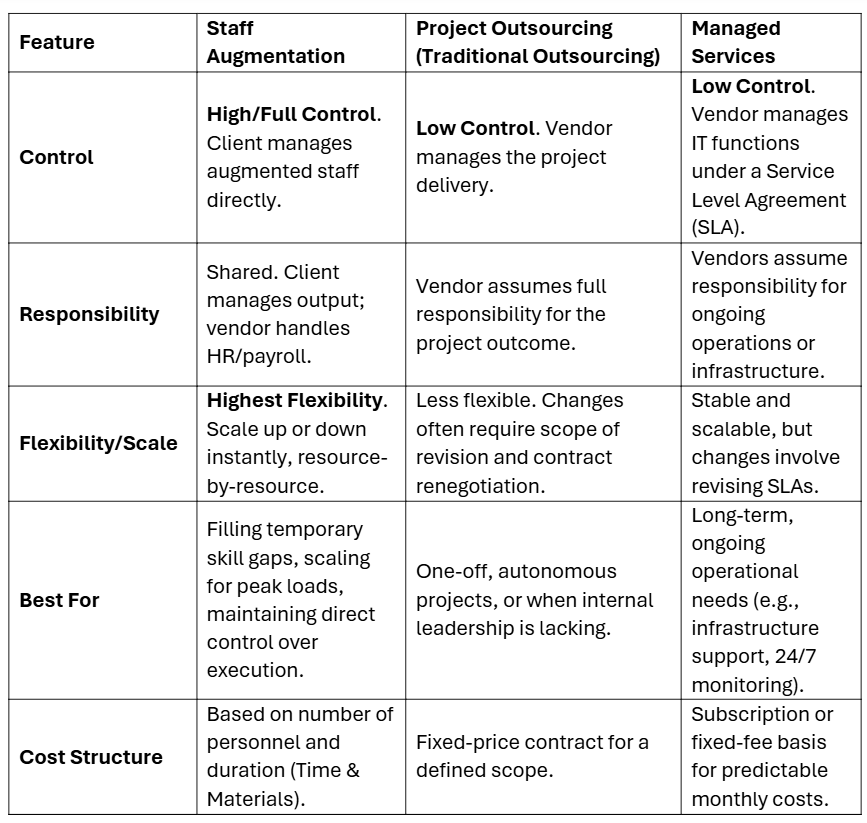
Staff augmentation shines when you have a clear roadmap and strong internal leadership but lack the specific human resources to execute, offering a faster path to talent than traditional recruitment. For organizations seeking a balanced approach, Axalin offers flexible engagement models, including a Build-Operate-Transfer (BOT) approach, which provides a path from augmentation to a dedicated team, if desired.
Types of Staff Augmentation Models
Staff augmentation can be broadly categorized into three types: onshore, offshore, and nearshore. Each of these models offers different advantages and challenges, depending on the location of the augmented staff and your business needs.
1. Onshore Staff Augmentation
Onshore staff augmentation is hiring professionals who are working in the same country or region as the hiring organisation.
Advantages:
- Cultural and Communication Fit: Since the augmented staff is local, no barriers in language and culture make communication even smoother.
- Time Zone Compatibility: Normally, onshore staff would work in the same time zone, thus making collaboration more seamless. This facilitates real-time collaboration and faster issue resolution.
- Legal and Compliance Factors: Involved professionals are usually local; thus, there is no worry about complex international labour laws and tax issues.
Challenges:
- Higher Costs: Onshore staff augmentation is generally more expensive than offshore and nearshore models because the pay can be higher in the same country due to local salaries and living expenses.
- Limited Talent Pool: Depending on the location, the local talent pool might be limited, especially for niche skills like AI/ML or specialized cloud expertise.
2. Offshore Staff Augmentation
Offshore talent augmentation is when one seeks talent from outside the country (mostly low-cost labour countries) to bring it into the team. This model is often chosen by companies looking for the most significant cost savings. Axalin specifically offers Offshore Staff Augmentation as part of its Strategic Talent Solutions.
Benefits of offshore staff augmentation include:
- Value for Money (Cost Savings): Offshore employees often offer significant cost savings, as salary levels in certain countries are generally lower than in others (average salaries can be 40-70% below comparable onshore roles).
- Global Talent Pool Access: You get to access a very wide range of specialised professionals from all over the world. This is ideal for securing niche skills that are scarce locally.
- Scale and 24/7 Productivity: Virtual and offshore teams are the best ways to make your workforce scalable. The time zone difference can be leveraged for a "follow-the-sun" model, enabling around-the-clock development and faster cycles.
Challenges:
- Time Zone Differences: Sometimes, communicating with offshore staff takes a longer time because of the time zone differences.
- Cultural and Language Barrier: Working with teams having different cultures sometimes leads to miscommunication as well as delays in communication.
- Data Security Concerns: Perceived lower data protection from threats in certain offshore regions can discourage projects involving highly sensitive Intellectual Property (IP) or personal information.
3. Nearshore Staff Augmentation
Nearshore staff augmentation involves finding professionals who are located in neighbouring or adjacent countries. This model combines offshore staffing's cost savings with onshore convenience, striking a desirable balance.
Benefits include the following:
- Closer Time-Zone Alignment: Nearshore teams typically work in a very similar/close time zone to the client's time zone, where you will find much less hassle when compared to offshore teams.
- Lower Costs: Though not costlier than an offshore professional, hiring one for nearshore would cost you less than the onshore employee, offering moderate savings.
- Cultural Affinity: As people live closer together, there would be fewer cultural differences, thus making communication easier.
Advantages of Staff Augmentation
The strategic use of staff augmentation allows businesses to achieve unprecedented agility, cost control, and specialization.
Admission to Specialized Skills
Staff augmentation opens the door for corporations to enter a much wider talent pool where specialised skills not easily available within the current workforce may be sought after. Be it the required expertise in a specific technology, niche industry know-how (e.g., in Finance & Banking or Healthcare, which are areas of expertise for Axalin), or project management skills, staff augmentation allows quick scoping of professionals who are proficient in specified skill sets. This is critical for highly technical projects requiring cutting-edge knowledge in fields like AI Automation and Orchestration10.
Cost-Effective Services
It proves economical as opposed to hiring full-time employees. The business pays for the so-needed skills and expertise for the duration of the project or just for a single project, eliminating long-term costs that permanent employees incur, such as salary, benefits, and other overheads (i.e., office space, equipment, etc.). By outsourcing the staffing function, you reduce HR overhead and recruitment, training, and retention costs do not have to be observed.
Scale and Flexibility
Staff augmentation lets companies flexibly scale their workforce quickly based on fluctuating project needs. If there's a surge in workload or a temporary project in the company, you can augment your team with the right professionals so that work gets done on time without getting into permanent hiring. Once the project is done, external workers can be let go without the long-term commitment of permanent hires, bringing the flexibility to adapt to changing business needs. This capacity for on-demand scaling is why the market is projected to skyrocket to approximately USD 857.2 billion by 2031.
Speed and Efficiency
Hiring and onboarding full-time employees can be lengthy and expensive processes. Staff augmentation lets organisations fill the gaps in their teams faster. Professional staffing agencies, like Axalin with its dedicated Talent Acquisition Team11, typically maintain a pool of pre-vetted candidates, significantly reducing the long wait in searching for, interviewing, and hiring talent. This does not prevent quick turn-around times that let companies stay agile and keep their projects from derailing.
Lowered Risk and Administrative Burden
Employers outsource the staffing function to third parties, thereby mitigating the risks of full-time employment and alleviating burdens associated with such contracts. The vendor becomes the employee's legal employer and manages contracts, benefits, payroll, and compliance with labour laws. This is especially useful when sourcing directly from other regions or countries, where dealing with local labour laws may become difficult.
Focus on Core Competencies
By outsourcing highly specialised tasks to external talent, the internal team may concentrate on the more strategic priorities and core competencies of the business. This consequently increases overall productivity while enabling internal employees to concentrate their efforts on high-priority work, thereby enhancing the efficiency of the whole organisation. This is a core part of Axalin's mission—enabling organizations to harness technology's full potential.
Accessing Global Talent
Staff augmentation lets organizations leverage talents from all over the world. This is useful, especially when those companies need an employee with a rare skill, and the local market is quite limited in that regard. Hiring talent from around the world gives greater flexibility and access to the best professionals.
Challenges of Staff Augmentation
While highly advantageous, the staff augmentation model presents several challenges that must be proactively managed for success.
Management Complexity
It can be complicated to manage a team that includes both in-house employees and augmented staff. While the augmented staff work closely with the permanent employees, they are hired by a third-party vendor, which usually results in problems in managing their workflow, roles, and communication. It is essential to have clear guidelines and a structure on how to manage the augmented staff to ensure a sound collaboration approach.
Cultural and Communication Barriers
With an augmented team, particularly cases offshore or nearshore, different communication styles, work cultures, and time zone differences can create challenges. Barriers such as language, regional customs, and even the mutual concept of time zones might lead to misunderstandings, project delays, or low collaboration. However, utilizing collaboration tools and establishing core working hours can mitigate these issues.
Quality Assurance Problems
It is not always simple to ensure that quality is kept up between in-house personnel and augmented staff. Augmented staff may not be used to the internal processes and culture of your company. Precise performance criteria, regular reviews, as well as transformational oversight are necessary to guarantee that work output from augmented staff meets company expectations.
Risk of Dependency on Third-Party Vendors
Business dependency on staff augmentation after much reliance on third-party vendor services for sourcing talents can pose a risk. Over-reliance on a single vendor creates vulnerability if they fail to deliver, or if contracts end suddenly, which weakens internal resources. The solution is to maintain relationships with multiple vetted vendors and negotiate flexible contracts.
Coordination with Various Existing Teams
Augmented staff may struggle to fit into the existing team due to differences in work styles and team dynamics. Effective integration requires planning, effort, and a procedure for smooth onboarding, collaboration, and creating an all-inclusive sense of belonging.
Concerns about the Security and Confidentiality of Information
When an organisation works with external professionals, especially those offshore, it must ensure maximum data security and confidentiality. Augmented staff access sensitive company data or proprietary information, greatly increasing the risk of breaches. Rigorous security protocols need to be in place, and both NDAs and anti-theft or leakage prevention measures must be applicable for all third parties. Given that Axalin also provides robust Enterprise Security solutions, including threat detection and compliance13, partnering with such a full-spectrum provider helps mitigate this critical risk.
Legal and Compliance Problems
Employing augmented employees, especially from abroad, can bring with it a number of legal and compliance obstacles for a company. Labour laws, taxation mechanisms, and hiring regulations differ across diverse regions. The organization must ensure compliance in the jurisdiction of the augmented staff (e.g., GDPR, HIPAA).
Knowledge Transfer and Retention
A key challenge is the potential for knowledge loss when a contract ends. Augmented staff often join for a sprint, deliver value, and then move on, taking their expertise with them if proper documentation is not enforced. Structured handoffs and thorough documentation are non-negotiable best practices.
When an organisation works with external professionals, especially those offshore, it must ensure maximum data security and confidentiality. Augmented staff access sensitive company data or proprietary information, greatly increasing the risk of breaches. Rigorous security protocols need to be in place, and both NDAs and anti-theft or leakage prevention measures must be applicable for all third parties. Given that Axalin also provides robust Enterprise Security solutions, including threat detection and compliance13, partnering with such a full-spectrum provider helps mitigate this critical risk.
Legal and Compliance Problems
Employing augmented employees, especially from abroad, can bring with it a number of legal and compliance obstacles for a company. Labour laws, taxation mechanisms, and hiring regulations differ across diverse regions. The organization must ensure compliance in the jurisdiction of the augmented staff (e.g., GDPR, HIPAA).
Knowledge Transfer and Retention
A key challenge is the potential for knowledge loss when a contract ends. Augmented staff often join for a sprint, deliver value, and then move on, taking their expertise with them if proper documentation is not enforced. Structured handoffs and thorough documentation are non-negotiable best practices.
The Strategic Imperative: Axalin's Focus on People, Process, and Technology
At its core, staff augmentation is not just about filling seats; it is a strategic approach that should align with your business's foundational elements: People, Process, and Technology. Axalin is founded on this philosophy, working to empower people, optimize processes, and leverage technology to drive digital excellence and business success15.
A successful augmentation strategy requires a partner who understands this trinity:
- People: Sourcing the right specialized skills, fostering cultural fit, and ensuring effective integration of augmented staff into the in-house team.
- Process: Aligning external resources with internal workflows, implementing agile methodologies, and establishing clear performance metrics.
- Technology: Ensuring augmented staff are proficient in the required tech stacks (e.g., Cloud Platforms like AWS, Microsoft Azure, Google Cloud, or Applications like SAP, Oracle) and maintaining security across all digital assets.
Axalin applies this comprehensive approach through its high-level service offerings, which include Strategic Talent Solutions (Staff Augmentation) alongside Digital Transformation and Enterprise Security, ensuring a holistic solution instead of just providing manpower.
Best Practices for Successful Staff Augmentation
Successful integration of augmented staff requires rigorous preparation and continuous oversight.
1. Role Expectations and Clarity
Before the integration of augmented staff, one needs to be clear on roles, responsibilities, and expectations from internal and external team members alike. A clear, detailed job description helps one ensure that everyone knows what they should be doing and what their task is, so as to avoid any confusion and misalignment very soon. Set definite goals, deadlines, and Key Performance Indicators (KPIs) against which augmented staff are supposed to evaluate their work.
2. Understand and Decide on the Appropriate Vendor or Agency
The success of any hiring augmentation endeavour greatly depends on the specific vendor or agency that they choose to go with. Potential staffing agencies should be put under a critical search to include the attention paid to the type of expertise they have, their reputation out there, and their ability to provide high-quality candidates on every required skill.
Axalin, for instance, focuses on providing custom & tailor-made solutions specifically designed for each client's unique IT vision. This custom approach, supported by a dedicated account manager and a team of Multi-Vendor Technology experts, drastically reduces hiring risk and ensures better fit and accountability20.
3. Communication is Clear
There is a major emphasis on effective communication in the case of augmented staffing. Without consistent and open forms of communication, expected objectives for projects will be out of line, and they become unsuccessful. Have regular check-ins, video calls, and performance reviews where areas of concern can be addressed early. Project Management software can help check the progress and assessment with accountability and transparency. Agile practices and short sprints that include augmented staff are highly recommended for continuous alignment.
4. Efficiently Onboard and Integrate Augmented Staff
Some forms of onboarding are required even for temporary or contract staff. The augmented employee should be given the same orientation and induction as existing full-time team members. This includes introducing them to the company culture, internal processes, and any relevant tools or software they would need to use. Proper, effective onboarding is what makes it possible for external workers to feel part of the team and to be productive right from day one.
5. Nourish Synergy and Teamwork
Bringing together a team is key to the success of staff augmentation. You have to include and enable external staff to be part of your organization, notwithstanding the short duration of time they are in the company. Encourage collaboration between in-house and augmented staff through team-building activities, shared goals, and joint problem-solving. When augmented staff members work alongside permanent employees and integrate well with the team, the quality of output is improved, and the whole team dynamic gets enhanced.
6. Monitor Performance and Provide Feedback
The augmented staff would still require continuous feedback and monitoring of their performance to keep them on the right track. Create performance metrics and invite periodical assessment of progress. Constructive feedback and prompt addressing of matters are necessary to eliminate negative influences on the project or team morale.
The Future of Staff Augmentation: 2025 and Beyond
The IT staff augmentation market is undergoing a profound transformation, driven by emerging technologies and the permanent shift to remote work. Experts forecast explosive growth, indicating that flexible resourcing is becoming a mainstream strategy.
AI-Driven Recruitment and Talent Matching
Artificial Intelligence is revolutionizing how companies augment IT staff. Advanced AI algorithms now streamline the hiring process by automating candidate screening, matching skill sets with precise project needs, and even predicting future workforce requirements with greater accuracy. This means faster talent matching, significantly reducing time-to-hire.
Proliferation of Hybrid Workforce Models
Hybrid teams, consisting of on-site and distributed remote talent, offer unprecedented flexibility and access to global skill pools. The 'remote-first' hiring model is now mainstream, allowing organizations to tap into a wider talent pool while diminishing operational overhead and real estate expenses. Staff augmentation is perfectly positioned to facilitate this blend of on-site and global expertise.
Precision Skill-Based Augmentation
Organizations are moving beyond generic job titles and are instead seeking augmented talent with very specific, verified skill combinations. The demand is surging for niche skills in cutting-edge technologies like AI/ML developers, Prompt Engineers, cloud security specialists, and DevOps engineers. Staff augmentation is the most efficient method for acquiring this specialized expertise without the risk of long-term commitment.
Outcome-Based Engagement and Ethical Workforce Practices
The industry is shifting towards outcome-based staff augmentation contracts tied to specific Key Performance Indicators (KPIs) and deliverables, moving beyond traditional hourly billing. Furthermore, there is a growing focus on ethical workforce practices and ensuring data security protocols are embedded into every contract, addressing past concerns about data confidentiality.
Conclusion
Staff augmentation comes with many associated benefits, including specialized talent, cost efficiency, and flexibility. For companies that want to scale rapidly, address immediate needs, or require specialized skills, employee augmentation can certainly break the bank.
However, it is necessary to compare advantages against challenges such as complicated management systems, cultural distance, and legal binding for efficient implementation. Clear communication, a strong project manager, and frequent checks are vital in ensuring the smooth and successful integration of augmented staff into the team.
This is the type of methodology that enhances a group’s prowess and enables such an organization to achieve its objectives faster and more efficiently. By blending its technical prowess with sharp business insight, Axalin empowers organizations across the spectrum, from start-ups to enterprises, to unlock technology's full potential, fostering innovation and securing long-term success through transformative IT solutions and Strategic Talent Solutions.