Cloud Migration Consulting Services in Bangalore: The Enterprise Leader's Strategic Guide
Why Bangalore Is India's Cloud Migration Epicenter
Bangalore, known as India's Silicon Valley, has evolved beyond a technology services hub. By 2025, it will serve as the command center for enterprise digital transformation across South Asia. With over 5,000 tech companies, more than 400 global capability centers, and a vibrant startup scene that generated 12 unicorns in 2024, the city's enterprise IT infrastructure faces intense pressure to modernize.
Cloud adoption among Indian enterprises is rising rapidly. According to IDC, cloud spending in India surpassed $8.3 billion in 2024, with organizations based in Bangalore taking a significant share. However, this rapid growth has led to challenges. Many organizations are moving quickly to the cloud without a clear strategy, resulting in higher costs, security vulnerabilities, and workloads that perform worse in the cloud than they did on premises.
Professional cloud migration consulting addresses this gap. A structured migration approach that includes assessment, architecture, governance, and change management can make the difference between gaining a competitive edge and accumulating costly technical debt.
The Bangalore Context:
Enterprises in Bangalore confront a unique mix of challenges. They face tight growth timelines, complex legacy systems from decades of IT services dominance, multi-cloud setups spanning AWS, Azure, and GCP, and a fierce competition for cloud-skilled talent that complicates building internal capabilities. Given these challenges, expert cloud migration consulting is not just a luxury; it is a strategic necessity.
What Is Cloud Migration?
Cloud migration involves moving an organization's digital assets—applications, data, workloads, and IT processes—from on-premises infrastructure or legacy data centers to cloud environments like Amazon Web Services (AWS), Microsoft Azure, or Google Cloud Platform (GCP). This process is not a one-time event but a structured program that includes assessment, planning, execution, and optimization phases.
The 6 Rs of Cloud Migration
The industry-standard framework for classifying migration strategies, known as the 6 Rs, outlines the approach for each workload:
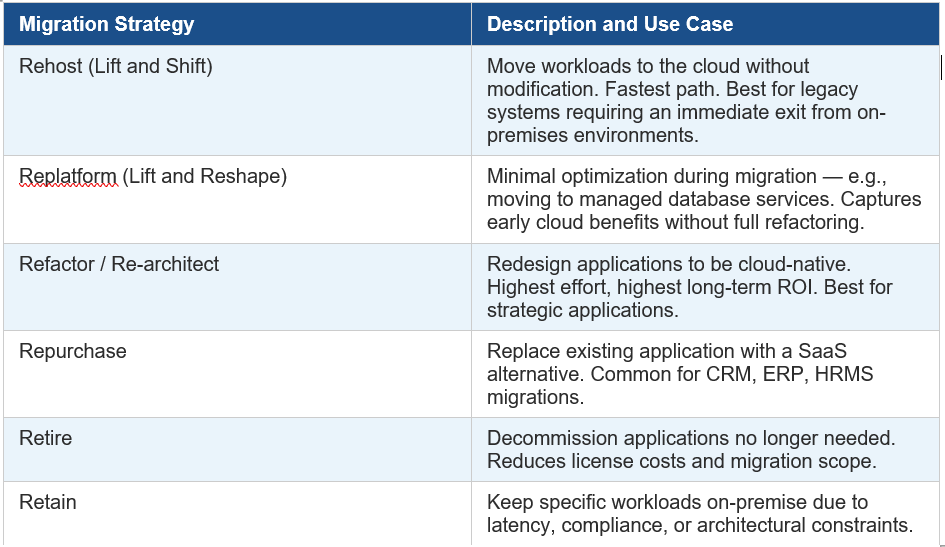
A qualified cloud migration consulting partner performs a detailed portfolio assessment to match the right R-strategy to each workload, ensuring the migration roadmap is both technically sound and financially optimized.
Why Cloud Migrations Fail Without Expert Consulting
Industry data is clear: 50 to 60% of cloud migration projects go over budget, and 38% take much longer than expected. The main problems are the same across regions and industries, and all of them can be addressed through structured consulting.
Challenge 1: Inadequate Discovery and Dependency Mapping
Organizations often underestimate the complexity of their application environments. Without thorough discovery, which includes mapping every application dependency, data flow, integration, and third-party connection, migrations lead to failures when downstream dependencies break in the cloud.
Challenge 2: Treating Cloud Migration as a Technical Project, not a Business Transformation
Cloud migration is really a business transformation supported by technology. When it is treated solely as an IT project, without executive backing, change management, or tracking business outcomes, it gets stuck at the infrastructure level. This fails to provide the agility, cost savings, or innovation benefits that justified the investment.
Challenge 3: Compliance and Security Blind Spots
Enterprises in Bangalore, especially in BFSI, healthcare, and e-commerce, must navigate complex regulations like RBI guidelines, the DPDP Act, HIPAA, PCI-DSS, and ISO 27001. Migrating to the cloud without a design that considers compliance risks exposes businesses to regulatory issues that can undermine the benefits of migration.
Challenge 4: Talent Gaps in Cloud Architecture and DevSecOps
There is a huge demand for certified cloud architects, DevOps engineers, and FinOps professionals in Bangalore. Organizations trying to carry out complex migrations with undertrained internal teams face architectural debt, security flaws, and operational instability that require costly fixes.
Challenge 5: Multi-Cloud Complexity
Most enterprises in Bangalore have mixed environments using AWS, Azure, and GCP, often due to acquisitions, departmental choices, or vendor diversification. Managing migration across multiple cloud platforms, each with different tools and governance, needs specialized multi-cloud knowledge that is hard to find within internal teams.
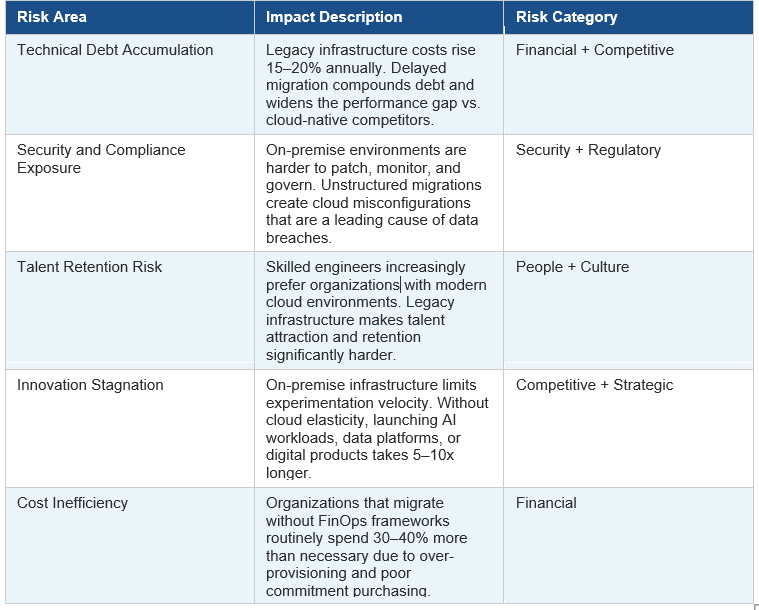
Strategic Risks of Delayed or Unstructured Cloud Migration
Cloud Migration Consulting Framework: Axalin’s 5-Phase Approach
Successful cloud migration requires more than simply moving workloads from on-premises infrastructure to the cloud. It demands a structured approach that balances speed, operational stability, and risk management.
Axalin follows a proven five-phase cloud migration framework designed to help enterprises transition to the cloud in a controlled, secure, and scalable manner. This methodology has been applied across complex migration engagements in Bangalore and other enterprise environments, ensuring minimal disruption and measurable business value.
Phase 1: Discover and Assess
Objective: Gain a comprehensive understanding of the current IT landscape before initiating any migration activities.
The first step in any migration journey is building a clear picture of the organization’s existing infrastructure, applications, and dependencies. Without this visibility, migrations can introduce unnecessary risk.
Key activities include:
Application Portfolio Analysis
All applications are catalogued and evaluated based on their business importance, technical architecture, and readiness for cloud deployment. This helps identify which workloads can migrate quickly and which require redesign.
Dependency Mapping
Inter-application dependencies, data flows, APIs, and integration points are documented. Understanding these relationships ensures that migrations occur in the correct sequence and prevent service interruptions.
Infrastructure Assessment
Existing servers, storage systems, network architecture, and security controls are reviewed to understand how they will translate into cloud infrastructure.
Compliance and Regulatory Review
Industry and regional compliance requirements—such as RBI guidelines, DPDP regulations, PCI-DSS, and HIPAA—are mapped to future cloud architecture and operational controls.
Business Case Development
A detailed financial model is prepared outlining the total cost of ownership (TCO), expected ROI, and payback period. This helps leadership teams make informed investment decisions and secure executive sponsorship.
Phase 2: Design and Architecture
Objective: Build a secure, scalable, and cost-efficient cloud architecture before any workloads are migrated.
Once the current environment is fully understood, the next step is designing the target cloud architecture.
Key activities include:
Landing Zone Design
A secure cloud foundation is established using frameworks such as AWS Control Tower, Azure Landing Zones, or GCP organizational policies. This includes account structure, networking (VPC/VNet), identity federation, and baseline security controls.
Security Architecture
Security is embedded into the architecture from the start through Zero Trust principles, identity and access governance, encryption standards, and integration with SIEM platforms for security monitoring.
Migration Wave Planning
Workloads are grouped into structured migration waves based on dependency mapping, business criticality, and operational risk. This phased approach reduces disruption and simplifies rollback if necessary.
FinOps Architecture
Cost governance is established early through resource tagging, budget controls, and reserved capacity planning to optimize long-term cloud spend.
Phase 3: Migrate and Modernize
Objective: Execute migration safely while ensuring operational continuity and data integrity.
With architecture and governance frameworks in place, the migration process begins.
Key activities include:
Automated Migration Tooling
Tools such as AWS Migration Hub, Azure Migrate, Google Migrate for Compute, and specialized partner solutions are used to accelerate migrations while maintaining auditability.
Secure Data Migration
Technologies such as database replication and Change Data Capture (CDC) ensure that data remains consistent and that no information is lost during the migration process.
Parallel Run and Controlled Cut-Over
Legacy and cloud environments are operated in parallel during the transition. Clearly defined cut-over windows and rollback procedures ensure business continuity.
Cloud-Native Refactoring
Where beneficial, applications are modernized by decomposing monolithic architectures into microservices, containerizing workloads with Docker and Kubernetes, and implementing CI/CD pipelines to enable faster deployments.
Phase 4: Operate and Optimize
Objective: Establish stable cloud operations and continuously optimize performance, security, and cost.
Once workloads are running in the cloud, organizations must shift their focus to operational excellence.
Key activities include:
Cloud Operations Centre
Monitoring and operational visibility are implemented using tools such as CloudWatch, Azure Monitor, and Datadog, along with structured incident response playbooks.
FinOps Programmed
Ongoing cost optimization is achieved through resource right-sizing, purchasing reserved capacity, tagging governance, and regular cost review cycles.
Continuous Security Monitoring
Security posture is maintained through SIEM integration, vulnerability scanning, and automated compliance reporting, ensuring that regulatory requirements are met.
Phase 5: Innovate and Scale
Objective: Use the cloud platform as a foundation for innovation and long-term business growth.
Cloud migration is not the end of the journey—it is the starting point for digital transformation.
Key activities include:
AI and Data Platforms
Organizations can leverage cloud-native capabilities to build machine learning pipelines, data lakes, and advanced analytics platforms that drive data-driven decision-making.
Application Modernization
Legacy workloads that were initially migrated using lift-and-shift strategies can be progressively modernized into fully cloud-native architectures.
Multi-Cloud Governance
Enterprises operating across AWS, Azure, and Google Cloud can implement unified governance frameworks that provide consistent policy enforcement and operational visibility across all environments.
Technology Enablement: Cloud Platforms and Tools
Platform / Tool | Key Services Used | Strategic Fit |
Amazon Web Services | EC2, RDS, S3, EKS, Lambda, AWS Migration Hub, Control Tower, AWS DMS, Cost Explorer | Strongest for compute-intensive, AI/ML, and data workloads |
Microsoft Azure | Azure Migrate, Azure Arc, Azure DevOps, Azure AD, Azure Sentinel, Azure Landing Zones | Best for Microsoft-stack enterprises and hybrid cloud scenarios |
Google Cloud Platform | GCP Migrate for Compute Engine, BigQuery, Anthos, Cloud Spanner, Cloud Armor | Optimal for analytics-heavy, Kubernetes-first, and AI/ML organizations |
Observability | DataDog, New Relic, Splunk for unified monitoring across multi-cloud environments | Cross-platform performance visibility and alerting |
Security | Okta (IAM), SentinelOne (EDR), Acronis (backup), Armis (asset intelligence) | End-to-end security from identity to endpoint to network |
DevOps | Atlassian (Jira/Confluence), GitHub, Jenkins, Terraform, and Ansible for infrastructure as code | Automated, repeatable, auditable migration and deployment pipelines |
Talent and Process Alignment: The Human Architecture of Migration Success
Technology often gets the most attention during a cloud migration, but it is rarely the deciding factor in success. In practice, technology accounts for only about 40% of a successful migration. The remaining 60% depends on people, processes, and governance.
This human and operational dimension is frequently underestimated. Yet, it is also the most common reason migrations stall, exceed budgets, or fail to deliver expected outcomes. Organizations that treat migration as purely a technical exercise often struggle with coordination gaps, unclear ownership, and operational instability after workloads move to the cloud.
Building the right organizational structure around migration is therefore just as critical as designing the technical architecture.
Building the Right Migration Team
Successful cloud migration programs require a multidisciplinary team working in close coordination. Each role contributes a distinct capability that ensures the migration progresses smoothly from planning through post-migration operations.
Cloud Architects
Cloud architects define the overall platform design, establish the landing zone architecture, and ensure that the target environment is secure, scalable, and aligned with enterprise governance standards.
DevSecOps Engineers
DevSecOps engineers build and automate CI/CD pipelines while embedding security controls directly into the development and deployment process. Their role ensures that security and compliance are integrated from the beginning rather than added later.
Database Administrators (DBAs)
DBAs manage one of the most critical aspects of migration: the safe and reliable movement of data. They design replication strategies, implement data synchronization methods, and validate integrity throughout the migration process.
Change Management Specialists
Technology change must be accompanied by organizational change. Change management specialists coordinate stakeholder communication, user training, and adoption strategies to ensure that new cloud-based workflows are understood and embraced across the business.
FinOps Practitioners
Cloud offers a fundamentally different cost model than traditional infrastructure. FinOps specialists establish cost governance frameworks, optimize resource utilization, and manage long-term commitment purchasing strategies such as reserved capacity.
Together, these roles form the core migration delivery team, balancing technical execution with operational governance.
Offshore and Onshore Staff Augmentation
Many enterprises in Bangalore and other technology hubs face a common challenge: the demand for experienced cloud professionals often exceeds the available internal talent pool.
Staff augmentation offers a practical solution by providing immediate access to pre-vetted, certified cloud migration specialists without the delays associated with recruitment.
Axalin’s Strategic Talent Solutions practice supports organizations through both offshore and onshore talent deployment. This includes AWS-certified cloud architects, DevOps engineers, security specialists, and migration engineers who integrate directly into client teams.
By embedding experienced professionals within existing delivery structures, organizations can accelerate migration timelines while maintaining operational continuity.
Build-Operate-Transfer for Long-Term Capability
While IT staff augmentation addresses immediate talent needs, many organizations ultimately want to build their own internal cloud capabilities rather than depend indefinitely on external managed services.
Axalin’s Build-Operate-Transfer (BOT) model is designed to support this objective.
Under this approach:
- Build: Axalin establishes the cloud operations function, including tooling, governance frameworks, and operational processes.
- Operate: The function is operated jointly until it reaches operational maturity and stability.
- Transfer: Full ownership is transferred to the internal team, supported by comprehensive documentation, runbooks, and training.
This model ensures that organizations gain sustainable, long-term cloud capabilities while reducing dependency on external vendors.
Cloud Migration for Bangalore’s Key Industry Verticals
While the core principles of cloud migration remain consistent, each industry faces unique regulatory requirements, operational challenges, and performance expectations. A successful migration strategy must therefore be tailored to the realities of each sector.
In Bangalore’s diverse technology and business ecosystem, organizations across finance, e-commerce, healthcare, and manufacturing are increasingly adopting cloud infrastructure to support growth, innovation, and resilience. Axalin designs industry-specific cloud architectures that address both regulatory obligations and business performance needs.
Finance and Banking (BFSI)
Bangalore’s banking and financial services sector operates under strict regulatory oversight from the Reserve Bank of India (RBI), while also facing intense competition from agile fintech companies.
Cloud adoption in this environment requires a compliance-first architecture that balances innovation with regulatory adherence.
Key considerations include:
- Data residency controls to ensure sensitive financial data remains within approved jurisdictions
- Encryption at rest and in transit to protect customer and transaction information
- Comprehensive audit logging to support regulatory reporting and operational transparency
Axalin brings BFSI-focused cloud governance frameworks that align with RBI’s operational risk management guidelines. In many cases, this involves implementing hybrid cloud architectures, where highly sensitive core banking workloads remain on-premises while customer-facing applications, analytics platforms, and digital services run in the cloud.
This approach enables financial institutions to innovate faster while maintaining full regulatory compliance.
E-Commerce and Retail Technology
Bangalore’s e-commerce ecosystem—ranging from direct-to-consumer (D2C) startups to large digital marketplaces—operates in a highly dynamic environment where demand can surge dramatically during promotional events.
Traditional on-premise infrastructure struggles to handle these spikes efficiently. Cloud infrastructure, however, provides elastic scalability, allowing resources to expand or contract automatically based on real-time demand.
Axalin supports e-commerce organizations by designing microservices-based architectures combined with intelligent auto-scaling policies. These systems can absorb traffic spikes of 10x or more during peak sales events without compromising application performance.
In a sector where page load speed directly affects conversion rates, this level of scalability becomes a significant competitive advantage.
Healthcare and Life Sciences
Healthcare organizations in Bangalore increasingly rely on digital platforms for patient management, telemedicine, and clinical data analytics. However, these innovations must operate within strict regulatory frameworks governing patient data privacy and security.
Healthcare providers must address compliance requirements such as:
- HIPAA regulations for patient data protection
- India’s Digital Personal Data Protection (DPDP) Act
- Emerging data localization requirements
Axalin designs HIPAA-compliant cloud architectures that incorporate end-to-end encryption, role-based access control, and immutable audit logs. These safeguards allow healthcare organizations to leverage cloud capabilities while maintaining the highest standards of data protection and regulatory compliance.
The result is a secure digital foundation for next-generation healthcare platforms.
Manufacturing and Logistics
Bangalore’s manufacturing and logistics sectors are rapidly embracing Industry 4.0 technologies, including IoT-enabled devices, predictive maintenance systems, and advanced supply chain analytics.
These data-intensive workloads require scalable infrastructure capable of processing large volumes of real-time operational data.
Axalin supports manufacturing and logistics companies by:
- Migrating and modernizing ERP platforms such as SAP and Oracle
- Building IoT data ingestion pipelines that capture machine and sensor data
- Implementing edge-to-cloud architectures that connect factory-floor systems with central analytics platforms
This integration enables organizations to move from reactive operations to predictive, data-driven decision making, improving efficiency across production, inventory management, and logistics networks.
Measurable Outcomes: What Structured Cloud Migration Delivers
Outcome | Benchmark Target |
Infrastructure Cost Reduction | 25–40% reduction in total infrastructure cost within 12–18 months post-migration |
Application Deployment Velocity | 3–5x faster application deployment with CI/CD pipelines and cloud-native architectures |
Security Posture Improvement | 60–70% reduction in mean time to detect (MTTD) with cloud-native SIEM and monitoring |
Scalability | Elastic capacity handling 10x load spikes without pre-provisioning or capital expenditure |
Compliance Coverage | Automated compliance reporting against RBI, PCI-DSS, ISO 27001, and HIPAA frameworks |
Business Continuity | 99.99% availability SLAs are achievable with multi-AZ and multi-region cloud architectures |
Developer Productivity | 40–50% improvement in developer productivity with automated pipelines and self-service infrastructure |
FinOps Maturity | Progression from reactive billing to proactive FinOps governance within 6–9 months |
Why Axalin Is Bangalore's Preferred Cloud Migration Consulting Partner
When Bangalore enterprises evaluate cloud migration consulting partners, they face a crowded market of generalist IT vendors, large system integrators, and boutique consultancies. Axalin occupies a distinct position — as a strategic transformation partner that combines multi-vendor cloud expertise, advisory depth, and a delivery model designed for long-term client success.
1. Multi-Cloud Architecture Expertise
Axalin is a certified partner across Amazon Web Services, Microsoft Azure, and Google Cloud Platform — the three hyperscale's most commonly deployed by Bangalore enterprises. Unlike partners locked into a single-cloud relationship, Axalin provides genuinely independent architecture advice, recommending and implementing the platform combination that best serves your workload requirements, compliance obligations, and commercial objectives. Our technology ecosystem further extends to SAP, Oracle, Okta, SentinelOne, DataDog, Splunk, and Atlassian — ensuring that cloud migration integrates seamlessly with your existing enterprise application landscape.
2. Compliance-Aware Cloud Architecture
Axalin's cloud architects combine deep platform expertise with regulatory intelligence. For BFSI clients, we design RBI-compliant cloud architectures. For healthcare, HIPAA and DPDP-compliant environments. For e-commerce, PCI-DSS-certified payment data architectures. Compliance is built into the design phase — not retrofitted after migration — eliminating the costly remediation that organizations experience when security and governance are treated as afterthoughts.
3. Custom, Tailor-Made Migration Roadmaps
Axalin approaches every migration engagement with a blank whiteboard. We do not apply template solutions to complex enterprise environments. Our architects conduct detailed discovery — application portfolio analysis, dependency mapping, compliance review, and business case modelling — before designing a migration roadmap that is specific to your infrastructure, your industry, your timelines, and your business outcomes. Every Axalin engagement is unique by design.
4. Dedicated Account Management and CoE Contribution
Every Axalin client receives a dedicated account manager who is accountable for delivery quality and client outcomes throughout the engagement. Beyond account management, clients benefit from Axalin's Centre of Excellence (CoE) — a cross-industry intelligence repository of migration patterns, compliance frameworks, and cloud architecture best practices developed across our portfolio. Your migration benefits from lessons learned across dozens of enterprise transformations.
5. Build-Operate-Transfer for Internal Capability Building
Axalin's Build-Operate-Transfer engagement model is the antidote to permanent vendor dependency. We build your cloud operations capability, operate it with your team during the maturation period, and transfer complete ownership — with trained engineers, documented runbooks, governance frameworks, and FinOps processes embedded. The goal is to make Axalin progressively unnecessary — because your long-term success is our measure of success.
6. Strategic Talent Solutions for Migration Acceleration
Axalin's dedicated Talent Acquisition Team places pre-vetted, certified cloud migration professionals — AWS Solutions Architects, Azure DevOps Engineers, Kubernetes Specialists, FinOps Practitioners — who can be onboarded rapidly and integrated into your migration program. Whether you need offshore augmentation for cost efficiency or onshore specialists for complex architecture work, Axalin's talent pipeline operates across both dimensions with equal depth.
7. Proven Across Bangalore's Priority Verticals
Axalin brings vertical-specific cloud migration intelligence across Finance and Banking, Healthcare, E-commerce, Logistics, Manufacturing, and Education — the industries that define Bangalore's enterprise landscape. This means your migration is designed and executed by consultants who understand your regulatory environment, your operational model, and the competitive dynamics specific to your industry.
The Axalin Difference:
One call. A dedicated team. A migration roadmap built specifically for your organisation — not adapted from a template. From discovery to cloud-native operations, Axalin is your strategic transformation partner for the entire journey.
Frequently Asked Questions (FAQs)
What does a cloud migration consulting company in Bangalore do?
A cloud migration consulting company assesses your existing IT infrastructure, designs a target cloud architecture, plans and executes the migration of applications and data to cloud platforms (AWS, Azure, GCP), and establishes cloud governance and optimization frameworks post-migration. A qualified partner also manages compliance requirements, security architecture, and change management throughout the program.
How long does a cloud migration project typically take in Bangalore?
Migration timelines depend on the size and complexity of the application portfolio, the migration strategy selected (lift-and-shift vs. refactoring), and the available team capacity. A small-to-mid enterprise migration with 20–50 applications typically takes 6–12 months. Large enterprise programs spanning 200+ applications and multi-cloud environments can take 18–36 months when executed in phased waves. A structured assessment phase always precedes an accurate timeline estimate.
What is the cost of cloud migration consulting services in Bangalore?
Cloud migration consulting costs vary significantly based on scope, engagement model, and the partner's expertise level. Broadly, organizations should budget for three cost components: the consulting fee (discovery, architecture, and program management), the migration execution cost (tooling, labor, and testing), and the ongoing cloud operations cost. A structured business case — comparing current TCO against projected cloud TCO — typically demonstrates positive ROI within 12–24 months of migration completion.
Which cloud platform is best for Bangalore enterprises — AWS, Azure, or GCP?
There is no universally correct answer. AWS offers the broadest service catalogue and is strongest for compute-intensive, AI/ML, and data workloads. Azure is optimal for Microsoft-stack enterprises (Office 365, Active Directory, Dynamics) and hybrid cloud scenarios. GCP excels for analytics-heavy, Kubernetes-first, and AI/ML organizations. Most large Bangalore enterprises operate multi-cloud environments combining two or three platforms. The right choice depends on your workload profile, compliance requirements, existing technology investments, and long-term strategic priorities.
What is the 6 Rs framework in cloud migration?
The 6 Rs — Rehost, Replatform, Refactor, Repurchase, Retire, Retain — is the industry-standard framework for classifying migration strategies at the workload level. Each workload in your application portfolio is assessed and assigned the most appropriate R-strategy based on business criticality, technical complexity, compliance requirements, and migration cost. This analysis is conducted during the Discovery and Assessment phase of a professional migration engagement.
How do you ensure security and compliance during cloud migration?
Security must be designed into the cloud architecture before migration begins, not configured afterwards. A compliance-aware migration engagement includes: regulatory mapping (RBI, DPDP, PCI-DSS, HIPAA, ISO 27001), security baseline configuration for cloud accounts, identity and access management (IAM) governance design, encryption standards for data at rest and in transit, network segmentation and Zero Trust architecture, and continuous compliance monitoring post-migration. For regulated industries in Bangalore, this is not optional — it is the foundation of migration planning.
What is a Build-Operate-Transfer model for cloud migration?
The Build-Operate-Transfer (BOT) model is an engagement structure where the consulting partner builds the cloud capability (architecture, operations, governance), operates it in partnership with the client team during a maturation period, and then transfers complete ownership to the client with trained personnel, documented processes, and embedded governance. BOT is ideal for organizations that want long-term internal cloud capability — rather than indefinite dependence on a managed services provider.
Can startups in Bangalore benefit from cloud migration consulting?
Absolutely. While large enterprises manage complex legacy migration programs, startups benefit from cloud architecture consulting at the foundation stage — ensuring their initial cloud environment is designed with scalability, security, cost governance, and compliance built in from day one. Starting with a well-designed cloud architecture is significantly less expensive than remediating a poorly architected environment after scaling. Axalin's flexible engagement models are designed to serve both early-stage startups and large enterprises with equally customized approaches.
Conclusion: Cloud Migration Is a Strategic Decision, not a Technical Project
For enterprise and mid-market organizations in Bangalore, the question is no longer whether to migrate to the cloud — it is whether to migrate strategically or reactively. The organizations that treat cloud migration as a technical project, delegated to an internal IT team without structured consulting support, consistently underdeliver on cost, security, and business outcome targets.
The organizations that engage experienced cloud migration consulting partners — with deep multi-platform expertise, compliance intelligence, and a structured 5-phase methodology — consistently achieve 25–40% cost reductions, 3–5x deployment velocity improvements, and a cloud foundation that enables AI, data, and product innovation at competitive speed.
Bangalore's competitive intensity makes this distinction consequential. In a city where your competitors are adopting cloud-native architectures, shortening their product cycles, and deploying AI at scale, the cost of delayed or unstructured cloud migration is not just financial — it is strategic.
Three Questions Every Enterprise Leader Must Answer:
1. Why now? Because every quarter of delayed migration is a quarter of compounding technical debt, rising on-premises costs, and a widening competitive gap.
2. What happens if leadership delays? Talent departure accelerates. Legacy costs rise. Innovation velocity slows. Regulatory risk compounds.
3. What differentiates mature organizations? Structured, data-driven, compliance-aware migration programs executed with expert consulting partners — not reactive, ad hoc cloud adoption driven by departmental pressure.
Cloud migration, done right, is not a cost center. It is a strategic investment that returns competitive agility, cost efficiency, security resilience, and innovation capacity. Axalin exists to ensure Bangalore's enterprises make that investment wisely — and realize its full potential.
Ready to Plan Your Cloud Migration in Bangalore?
Connect with Axalin's cloud migration consultants for a complimentary infrastructure assessment and migration business case.
www.axalingroup.com | People. Process. Technology.